
VALD Testing: Understanding Strength, Power and Movement
October 14, 2026
VALD Testing in Perth: Understanding Strength, Power and Movement
When you are rehabilitating an injury or pursuing peak athletic performance, subjective feedback is only one part of the picture. Objective measurement provides the empirical data required to ensure progression is targeted, efficient, and measurable.
At Peak Podiatry, we utilise VALD high-precision dynamometry. By measuring force, rate of force development, range of motion, and bilateral asymmetry, we replace clinical guesswork with quantifiable metrics. This data allows us to identify underlying deficits, screen athletes for injury risk, and guide post-operative rehabilitation so our patients get stronger, faster.
What is VALD Testing?
VALD is a gold-standard suite of human measurement technologies designed to capture objective biomechanical and musculoskeletal data. Rather than relying on a single assessment, testing protocols are selected based on clinical presentation, athletic profile, and mechanical demands.
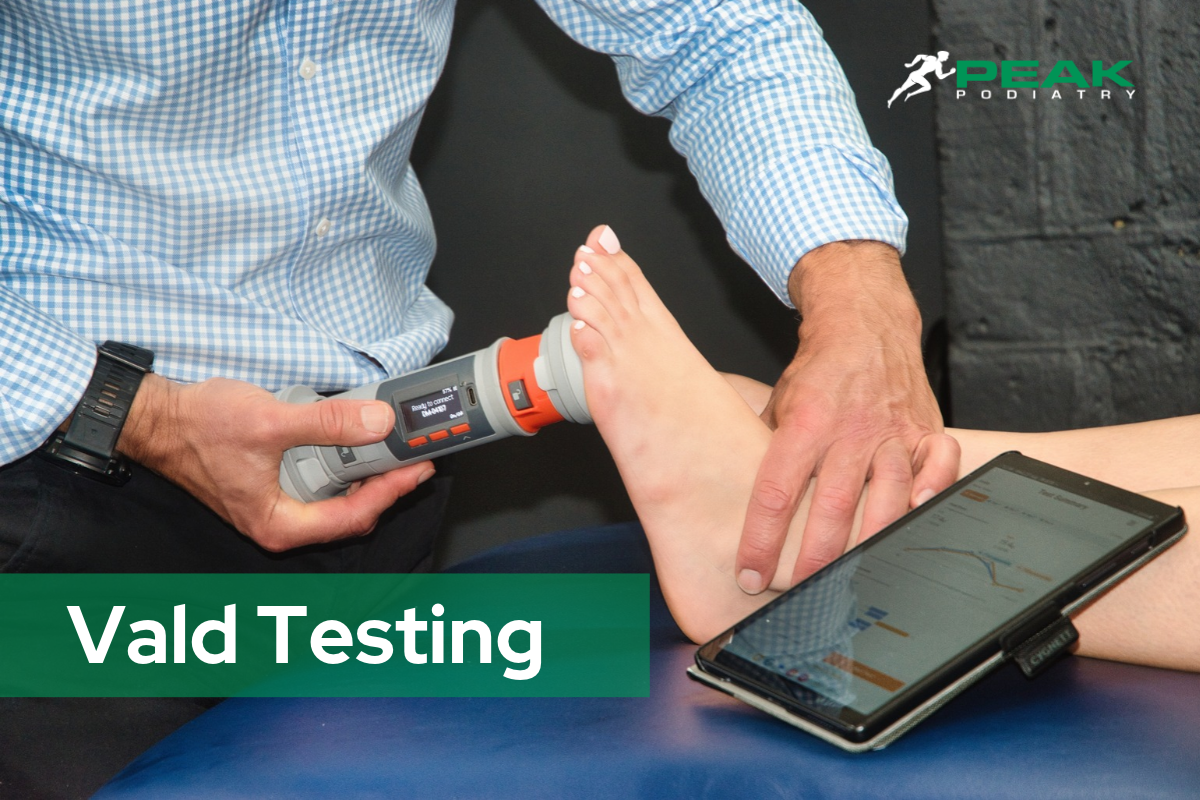
At Peak Podiatry, our testing framework integrates the VALD Dynamometer, a handheld device that we can use to isolate specific muscle groups to assess and record peak force production, rate of force development and active/passive range of motion throughout joints of the lower limbs.
Targeted Screening and Post-Operative Management
Generic rehabilitation protocols often fail because they assume a linear recovery curve that rarely matches biological tissue adaptation. We leverage VALD dynamometry across two critical clinical cohorts:
1. Pre-Season and Athletic Screening
High-performance running, jumping, and cutting athletes often develop compensatory movement patterns that mask isolated muscular weakness. By deploying isolated dynamometer testing, we screen athletes across key foot, ankle, calf, and hip musculature:
- Identification of Silent Deficits: Pinpoint subtle unilateral weaknesses (e.g., isolated soleus vs. gastrocnemius output, posterior tibialis capacity, or flexor weakness) before symptoms arise.
- Proactive Load Management: Direct strength and conditioning interventions specifically where capacity fails to meet mechanical load, mitigating the risk of soft-tissue failure and bone stress injuries.
2. Post-Operative Rehabilitation: Moving Beyond 'One-Size-Fits-All'
Post-surgical recovery, such as following Achilles tendon repair, ankle ligament reconstruction, or lower-limb osteotomies, demands far more precision than standard timeline-based protocols:
- Quantifiable Tissue Tolerance: Dynamometer testing allows us to track precise isometric force thresholds safely across early and intermediate phases of tissue healing.
- Eliminating Guesswork: We establish exact Limb Symmetry Indices (LSI) for peak force and joint excursion. We do not advance a patient to high-impact plyometrics or running simply because a set number of weeks have elapsed; we advance them when tissue capacity is proven using evidence-based criteria.
- Accelerating Safe Progression: By continuously auditing strength gains, we tailor loading parameters in real time, ensuring post-operative patients adapt quickly without overloading healing structures.
What Can VALD Systems Measure?
Depending on the specific test and device configuration, VALD provides high-resolution data on:
- Maximal Strength & Peak Force: Absolute output across targeted muscle groups.
- Rate of Force Development (RFD): The speed of explosive force production within the first 50–200 milliseconds of contraction.
- Range of Motion (ROM): Quantitative joint excursion angles to monitor mobility restrictions or mechanical capsular changes.
- Bilateral Asymmetry: Inter-limb discrepancies in force absorption, propulsion, and isometric torque.
Why Objective Testing is Critical for Rehabilitation
Symptom resolution does not equate to tissue restoration. Patients regularly present pain-free while exhibiting significant kinetic deficits. We use VALD to screen patients because symptom resolution does not mean functional deficits have been removed. By assessing even once the pain is gone, we can provide targeted loading plans to greatly minimise re-injury risk and get you back to doing what you love, for longer.
Without objective testing, an athlete cleared on symptoms alone may compensate by offloading the healing limb, placing downstream joints and tendons under unaccustomed stress.
Regular re-testing with the VALD dynamometer provides:
- Empirical Baselines: Objective data captured at initial consultation against which all subsequent interventions are benchmarked.
- Program Accountability: Proof of whether an exercise prescription is inducing true neuromuscular hypertrophy and capacity changes.
- Safe Return-to-Sport Clearance: Objective validation that strength, power, and movement strategies match pre-injury data or normative benchmarks.
Understanding Bilateral Asymmetry and Normative Data
Bilateral asymmetry is a fundamental metric in sports podiatry, but it requires nuanced interpretation. A minor limb asymmetry is normal in asymmetric sports (e.g., kicking, bowling, or unilateral throwing events). However, significant asymmetries, typically defined as an LSI difference greater than 10-15%, can alter kinetic chain load distribution and elevate re-injury risk.
VALD’s normative datasets draw from thousands of elite, collegiate, and recreational athletes globally. This allows us to compare a patient's absolute output and symmetry against relevant age-, sex-, and sport-matched cohorts. Norms do not serve as a rigid pass/fail criterion, but they provide invaluable context for determining whether an athlete has regained appropriate baseline capacity.
The Clinical Framework at Peak Podiatry
Technology alone does not resolve pathology; clinical expertise does. At Peak Podiatry, VALD metrics are integrated directly into our comprehensive clinical model:
- Initial Clinical Assessment: Subjective history, pain-mapping, mechanical gait analysis, and structural evaluation.
- Objective VALD Testing: Isolation of focal strength and joint ROM via dynamometer.
- Targeted Prescription: Implementation of targeted, load-managed strength protocols tailored to address demonstrated deficits.
- Iterative Re-Testing: Re-evaluating metrics at predetermined intervals to objectively justify load increases, return to running, or unrestricted competition
Access VALD Testing at Peak Podiatry
Whether you are rehabilitating post-surgery, recovering from recalcitrant lower-limb pain, or seeking an athletic screen to identify performance limiters, objective data removes the ambiguity.
Contact the team at Peak Podiatry to arrange your VALD assessment and secure a structured, measurable pathway back to full capacity.